Group One Comebackers (Part 1)
- Eric Xiao
- May 30
- 3 min read
The 2025 Chicago Bears earned the nickname "Cardiac Bears" for their uncanny ability to pull off dramatic late-game comebacks. In the Polish Premier League, Group One Team just as easily have earned a similar nickname.
Having already pulled off a 41 IMP comeback in an earlier playoff match, Group One Team once again found themselves facing a daunting deficit. After losing each of the first four sets over 48 boards, they trailed by 58 IMPs with only two sets remaining.
At that point, it seemed as though they would need a miracle to win the match. Instead, they made the comeback look normal.
Let's take a look at what happened in the fifth set.
The first major swing occurred on the opening board of the set.

After South's 2♣ artificial game-forcing bid, West decided to jump to 3♠ with the strongest hand at the table. Had West overcalled only 2♠, North would almost certainly have doubled for penalty. However, after a jump overcall, many partnerships play doubles by either side as takeout-oriented or showing shortness in the opponent's suit rather than penalty. This appears to have been the agreement for Zatorski and Zmuda, as North passed over 3♠.
South then bid 4♥ with three-card support, which Kalita doubled for takeout. Holding five trumps and little else of value, Klukowski elected to convert the double into penalty.
Once Klukowski led the ♣7, it was clear that a club ruff was likely to come through. Zatorski won with the ♣A in his own hand as Kalita followed with the ♣J. He then tried the ♦J, which was taken, after which West cashed the ♣K and returned a club to give East a ruff.
Klukowski then switched to a spade, which went to his partner’s king, and eight tricks were quickly claimed, as declarer could not avoid losing a fifth trick.

In the other room, the auction developed along a completely different trajectory. Rather than simply bidding his spade suit, Włodek Starkowski chose to cue-bid 2♥, which his partner then raised to 2♠. After Gawel jumped to 4♥, West overcalled 4♠, a decision that proved costly once Jagniewski doubled the game.
A low trump lead from South left declarer in serious trouble from the start. With the unfavourable spade break and no realistic way to ruff out all of dummy’s club losers, the declaring side could only manage seven tricks for –500. This resulted in 13 IMPs for Group One Team.
Kwiecień was likely left wondering why they had not simply defended 4♥.
The next significant swing arrived in the second half of the 12-board segment.

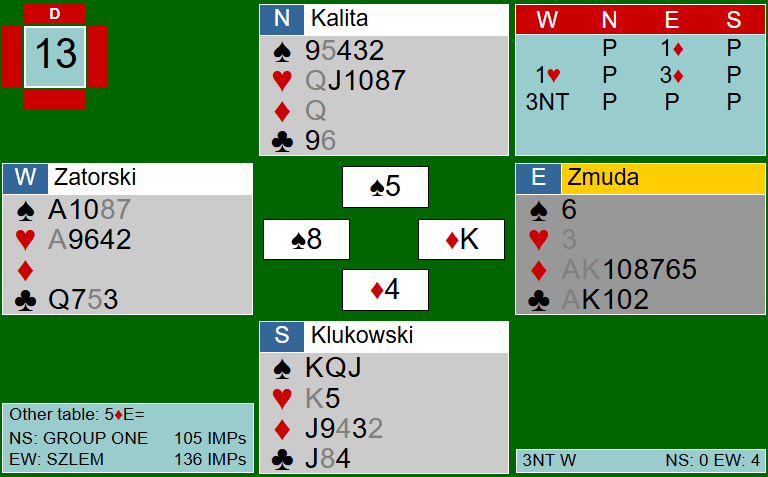
The auction at both tables was identical, with both South players opening 1NT despite holding a singleton ace.
Kalita led the ♠10, won by declarer’s queen. Zmuda shifted to a diamond to dummy’s queen, followed by a low club from dummy, but Klukowski ducked the club, allowing Kalita to win with his stiff king, who then returned a second spade.
After declarer knocked out the club entry, the defense took three spade tricks, resulting in a routine down one.

At the other table, the play followed the same line for the first three tricks. However, at trick four, East erroneously rose with the ♣A when a low club was led from dummy, felling partner’s king and allowing Jagniewski to come to 11 tricks.
This produced another 13 IMP swing for Group One Team, who reduced the overall deficit to 31 after winning the cumulative set by 27 IMPs. In addition to the two major swings, they also won the overtrick battle 4–3, ultimately taking the set 30–3.
However, there was still more work to be done in the sixth set, which will be covered in a separate section.


Comments