Are These Real Results
- Eric Xiao
- May 15
- 3 min read
In many sports, the number 21 is viewed as the magic number: the score needed to secure victory.
However, this number is not one you often see in the bridge world. Of course, you may hold a 21-point hand every now and then, or win a team match by 21 IMPs. But would you believe me if I told you that 21 IMPs were swung on a single board where one side bid and made a grand slam, while the other failed to make a small slam? Read below to see what transpired at both tables.
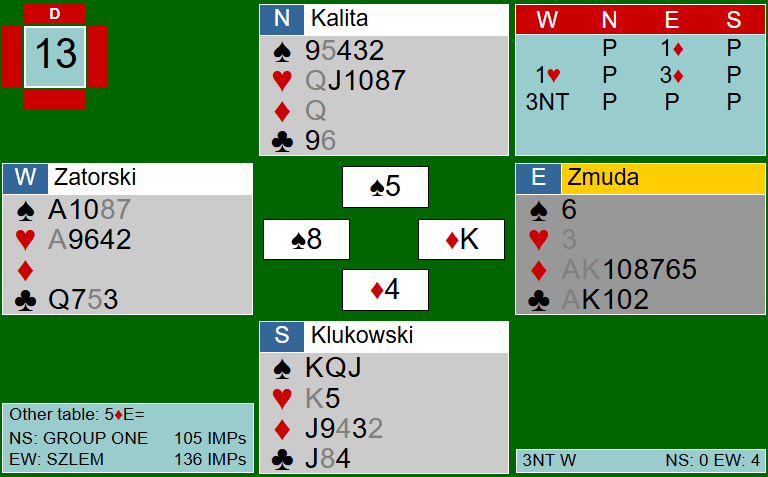
Board 6
Dealer: East
EW Vulnerable

Here's how the auction developed at one table:
West | North | East | South |
1NT (1) | 3♣ | ||
3♠ (2) | 4♥ | 5♦ | 5♥ |
6♦ | P | P | 6♥ |
6♠ | P | P | X |
AP |
1) 15-17
2) Game forcing with diamonds
The bidding itself is interesting because of the many reasonable ways each player could evaluate their hand. For starters, while the 1NT opening is generally considered normal, not all Easts would choose to open it, given the strength in spades and the weakness in hearts.
After South’s preemptive bid, West is faced with a choice of whether to introduce spades or diamonds first. With the given shape, it appears logical to show diamonds initially and plan a spade reverse later in the auction. However, that approach could easily backfire if North continues to pressure the auction with a bid such as 5♣, potentially forcing West to bid 5♠ to show the secondary suit. This presents a compelling argument for bidding the major suit first, allowing West to more efficiently describe their hand with a later 5♦ call.
After West chose to show diamonds with a conventional 3♠ bid, North-South were able to uncover their heart fit. South then decided to take a favorable sacrifice after the opponents had reached a makeable 6♦ contract. Unsatisfied with conceding a good result, West plausibly competed further to what appeared to be a reasonable 6♠ contract.
South made a standard Lightner double on the hand, and declarer knew they were doomed once a diamond was led.
On the other hand, the auction started similarly but quickly shifted in a different direction.
West | North | East | South |
1NT (1) | 3♣ | ||
3♥ (2) | 4♥ | 4♠ | 5♥ |
6♠ | 7♥ | 7♠ | AP |
1) 14-16
2) Invitational or better in spades
Here, West showed a preference for spades with the 3♥ bid, suggesting additional strength or length in the suit. North-South, meanwhile, found their heart fit, and as the auction escalated, West was pushed to compete further and eventually bid 6♠, fully concealing their diamond holding.
Surprisingly, North took the initiative to sacrifice over the vulnerable slam, which was then topped off by East’s questionable 7♠ bid. Without a first-round control in the opponents’ suit, East’s decision to bid 7♠ appears premature. A pass over 7♥ would more naturally suggest uncertainty, leaving the final decision to West and preserving flexibility between declaring and defending. Had East chosen that approach, the partnership would have collected +500 defending 7♥ doubled rather than risking the push to 7♠.
However, East-West escaped unpunished, as South failed to find the correct heart lead and instead led a club.
By why a heart lead instead of a club?
A club lead can never be a winning play here for two main reasons. First, North’s failure to bid 7♣ or otherwise suggest club strength implies that there are no immediate club tricks for the defense. Additionally, North could also have doubled 7♠ to suggest an unusual lead, steering partner away from a natural heart lead and toward a more effective defensive option.
However, the absence of either action suggests that the heart suit may be the source of the setting trick for the defense, making a heart lead the clearest defensive choice. Even with North-South setting 7♠ by two, assuming they would have found the diamond ruff after a heart lead, the result would still be a 7 IMP gain for the East-West pair.
The difference between +2210 and –500 amounted to 2710 points, yielding a 21 IMP swing on a single board. Deals like this illustrate how even a small number of reckless or inaccurate decisions can produce massive swings that are difficult to recover from, turning a single hand into the deciding factor of an entire match.


Comments