Between Theory and the Table
- Eric Xiao
- May 16
- 3 min read
After a rather aggressive and imprecise auction, you find yourself in a 6♥ contract missing three aces. Somehow, thanks to the double voids in both your hand and your partner’s hand, you have only one immediate loser.

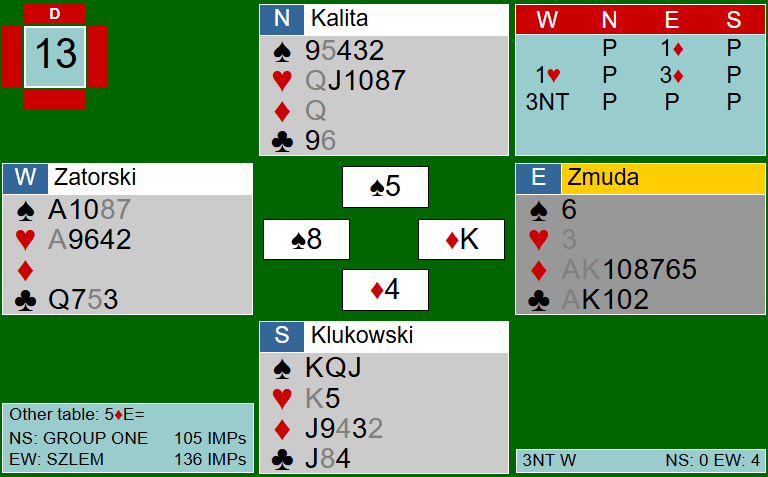
West leads the ♦K, which you promptly ruff, as shown in the diagram above.
How do you plan to make this contract?
There are many lines of play that might come to mind, including:
a ruffing finesse in the club suit
establishing the diamond suit in hopes of ruffing out the ace early
setting up spades and hoping they break 3–3
However, none of these lines are guaranteed, as they are not sufficiently likely from a probabilistic standpoint. A 3–3 spade break, for example, occurs only about 36% of the time, while playing West for an ace-king holding in diamonds is also relatively unlikely.
Additionally, one key inference can be drawn from the bidding: neither East nor West holds an opening hand, given their earlier passes. This makes it more likely that East holds the black-suit aces, as West’s lead of the ♦K further suggests an ace-king holding in diamonds. Had West held either black-suit ace, they would most likely have opened the bidding under modern standards.
The declarer play would appear straightforward if spades were 3–3, but could you still make the contract knowing they do not break favorably?
One possible line of play is to develop spades while ruffing clubs, by leading the suit from dummy. However, leading a high spade from dummy would be problematic.
Suppose that at trick seven you crossruff three rounds in diamonds and clubs (with none of the honors falling), and then proceed to lead the queen of spades from dummy.
East could duck the first spade if they held four cards in the suit, leaving you stranded in dummy, as a second spade lead would then allow the opponents to gain a ruff (as shown below).
Alternatively, continuing the crossruff in the minor suits would also fail, as although the fifth diamond becomes established, the opponents are still able to ruff in and disrupt control (also shown below).
Therefore, only a low spade play will suffice. Even if East holds four spades, there is nothing they can do to prevent the contract from making. If they rise with the ace and return a trump, the spades are established and only three club ruffs are required. If they duck, you can ruff the fourth club, ruff a diamond, draw trumps, and then establish the spade suit. Note that trumps must break 2–1 for this contract to succeed.
Below is the layout of the whole hand:

There are two things worth mentioning about this hand:
A trump lead by West would have defeated the contract, as declarer would not have been able to ruff all their club losers in time.
While this line is most successful from a mathematical standpoint, it may not be the most practical at the table, as playing for a 3–3 spade break might feel more natural in real-time decision-making. The line of play presented was based on the assumption that the spade distribution was unfavorable, and it would have failed if spades split 3-3.
In fact, as the declarer on this board, I did not find this optimal line. Instead, I chose the more practical line of leading the queen of spades from dummy at trick seven, which would have failed theoretically.
However, the East player at my table took the queen of spades and returned a trump, a decision that may have seemed natural at the table but ultimately proved costly. As a result, I was able to lead the fourth diamond from dummy, and the established diamond in dummy allowed me to pitch my fourth club loser, bringing the slam home. Therefore, this line of play may well have succeeded as the best practical approach, while also preserving a squeeze chance if East held a 4–1–3–5 shape.


Comments