Riga Round 25: England vs Denmark
With only a few rounds remaining, this match carried huge implications for both teams. England and Denmark were not only fighting to stay inside the top eight, but were also well within reach of the medals. A big win would strengthen both their qualification chances and their hopes of finishing on the podium, while a loss would make the final rounds far more stressful.

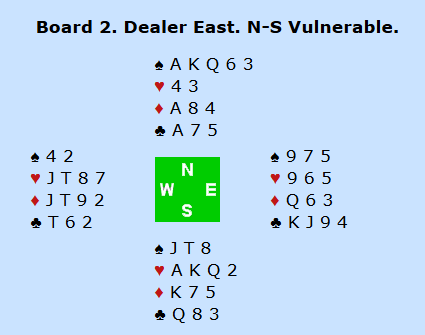
This was one of those gambling hands, with the East hand holding a long, solid source of tricks. The only problem was the club break. North held all of the outstanding clubs, instantly destroying what looked like a very promising 3NT contract. From that point on, the challenge was no longer how to make the contract, but rather how to minimize the damage once the bad break came to light.
Schaltz | Gold | Bilde | Paske |
1♣ | 1♠ | ||
X | P | 3NT | AP |
In 3NT, Paske led the ♠K, won by declarer's ace. Bilde naturally continued with a second spade to the queen. When Paske switched to a diamond, Bilde rose with the ♦K, although it made no difference since both missing diamond honors were offside. Gold won the ♦Q and returned another diamond, allowing dummy's ♦9 to win the trick.
Had clubs divided normally, Bilde appeared to have ten tricks. Instead, he discovered the disastrous club break and was limited to three club tricks, two spades, and one diamond, finishing six tricks in all. Down three was certainly not the worst result the Danes could have hoped for.
One interesting question is whether Gold could have justified doubling the final contract. Holding an opening hand opposite a vulnerable overcall, it was reasonable to place declarer with a long running club suit rather than a strong balanced hand. Even if the double was primarily lead directing toward hearts, dummy's first bid suit, it would not have backfired on this deal. My guess is that Gold simply judged partner to be too weak to make defending attractive.
Dyke | Plejdrup-Meister | Byrne | Lahrmann |
1♣ | 3♠ | ||
P | P | 3NT | AP |
Christian Lahrmann chose to preempt with his hand, but it ultimately steered the opponents into the same 3NT contract. The first two tricks followed the same path, although Lahrmann returned a third spade instead of switching to a diamond. Declarer finished with only three club tricks and two spades in this room, and Denmark picked up 3 IMPs on the board.

This board highlighted the importance of which side declared the contract, showing the reverse effect of what is normally considered right siding a contract.
Dyke | Plejdrup-Meister | Byrne | Lahrmann |
1NT | P | 3NT | AP |
Here, Dyke likely upgraded his 14 count, and the partnership reached a 23 point 3NT contract. While a spade lead from North would have defeated the game, Andreas Plejdrup-Meister chose a heart from his longest suit. Even after the heart lead, declarer still had a clear path to nine tricks: two hearts, one diamond, and five clubs, assuming clubs were not breaking 4-0.
Dyke began by working on clubs after winning the opening trick, and Lahrmann returned the ♥Q after taking the ♣A at trick two. Declarer then played a diamond from hand toward the ♦9, losing to Lahrmann's ♦J. On the second round of diamonds, Dyke successfully took the finesse, securing his ninth trick.
The other table had a slightly more complex auction:
Schaltz | Gold | Bilde | Paske |
1♣ | P | 1♥ | 1♠ |
2♣ | 2♠ | 2NT | P |
3NT | AP |
Martin Schaltz began with a 1♣ opening, hoping to emphasize his long club suit. While he successfully showed his clubs later in the auction, the downside was that it allowed the opponents to uncover their spade fit. In 3NT, the defense quickly took four spade tricks and the ♣A after Paske led a spade.

Looking at all four hands, it appeared that North-South could take twelve tricks as long as they guessed the diamonds correctly and did so in time. To reach that number of tricks, declarer had to attack diamonds immediately rather than drawing trumps first.
At the table, this would have been nothing more than a pure guess. The bigger question was whether anyone could find the winning line, even without reaching slam. Surprisingly, only four of the thirty tables managed to take twelve tricks, and only one of those pairs reached the slam.
Schaltz | Gold | Bilde | Paske |
P | 1♠ | P | 2♦ |
P | 2♠ | P | 4♥ |
P | 4NT | P | 5♣ |
P | 5♦ | P | 6♦ |
P | 6♠ | AP |
We were presented with a classic 2/1 auction, where opener's 2♠ rebid did not necessarily promise six spades. To my surprise, Paske immediately jumped to 4♥ with his hand. Holding a minimum for his 2/1 response and potentially only an eight card fit, he made an aggressive splinter bid in a suit where he held a singleton honor. A more conservative approach would have been to bid 3♠ and decline a non-serious 3NT slam try, assuming Gold would have made that bid with serious interest.
Instead, the 4♥ splinter caused Gold to reevaluate his hand. Holding three keycards and Axx of hearts, he had nearly the perfect holding opposite partner's singleton. This pushed them into a small slam that was not ideal, but still had a chance to succeed.
Bilde started with a club lead, which Gold won in hand. Knowing dummy had limited entries, declarer immediately attacked diamonds by leading low toward the ♦J. Rather than returning a club to put additional pressure on declarer, Schaltz switched to a low heart, which Gold won with the ♥A before continuing diamonds. Once trumps split 3-2, declarer claimed eleven tricks.
Perhaps, in hindsight, declarer might have preferred to see a bad trump break, as it would have made the game contract unsuccessful and avoided the difficult slam decision altogether.
Dyke | Plejdrup-Meister | Byrne | Lahrmann |
P | 1♠ | P | 2♦ |
P | 2♠ | P | 3♠ |
P | 3NT | P | 4♣ |
P | 4♥ | P | 4♠ |
AP |
Rather than splintering, Lahrmann chose the more natural 3♠ raise and continued with a 4♣ cue bid. However, the partnership eventually stopped in game after discovering that there was no diamond control for slam.
Similar to the other room, Kieran Dyke won the ♦Q at trick two, but he found the important continuation of returning a club. After winning with dummy's ace, declarer played a low diamond, allowing East's ♦10 to win and cash the club winner. Byrne then continued with a heart, which declarer won before crossing to dummy with a spade and ruffing a diamond.
Although even 4♠ was far from secure, the Danes managed to bring home the contract and earned 10 IMPs to win the match 30–22.


Comments