Riga Round 27: Switzerland vs Belgium
On the schedule, Switzerland was set to face several of the tournament's strongest contenders near the end of the round robin. Their opponents this time were Belgium, who sat in 13th place, eight victory points behind Switzerland, who occupied 12th.
The Swiss entered the match having already lost five consecutive matches, including recent defeats against Norway, Bulgaria, and Denmark. Unfortunately, the bleeding continued. Despite seven push boards in the set, Switzerland was overwhelmed once again, this time losing by 43 IMPs.
In sports, when one side concedes early due to their own mistake, it often gives the opponent immediate momentum while making a comeback much more difficult. Recovering from an early setback is already challenging, but doing so after an avoidable error can make the uphill battle even steeper.
This was certainly evident after the first board of the match, as Switzerland immediately found themselves chasing an early self-inflicted setback.

Klukowski | De Donder | Kalita | Bahbout |
1NT | P | 2♥ | |
P | 2NT | P | 3NT |
P | 4♠ | AP |
2NT here was a superaccept, showing a balanced hand such as 4-3-3-3. Steve De Donder declined partner's invitation to play 3NT, instead retreating to 4♠. Ten tricks were quickly claimed after the ♦K lead on BBO. I assume declarer did not take the spade finesse and instead relied on the natural play of the suit.
Arts | Multon | De Roos | Nowosadzki |
1NT | P | 2♥ | |
P | 2NT | P | 3NT |
AP |
The auction was similarly straightforward to the Belgian table, but Multon accepted the invitation to play in 3NT. East seemed eager to lead a diamond, given his strength in the suit alongside a side suit ace. Looking at all four hands, 3NT appeared to have nine tricks available, as long as the ♠K was onside and spades broke 2-2. Unfortunately, the main issue was the lack of entries to dummy, as the ♣Q was the only way back and would likely be needed to take the spade finesse.
If declarer chose to play the ♠Q, West could cover, forcing Multon to win with the ace. He would then have to continue with a spade toward the jack. However, the spade suit would become blocked, as dummy would have no remaining entry to cash the fifth spade.
Multon ducked the first two rounds of diamonds, pitching a club from dummy on the third round, while also discovering that West had started with only two diamonds. To avoid the entry problem, he shifted to a heart at trick four. East won the trick and proceeded to cash his remaining three diamond winners. Going down two resulted in 11 IMPs for Belgium on the opening board.

The set remained relatively quiet until this hand emerged. The most optimal contract would likely have been in a heart contract, as the unfavorable heart split made slam a dangerous proposition. But could either table find their way to the best spot?
Arts | Multon | De Roos | Nowosadzki |
2♦ (1) | P | ||
2♠ (2) | 3♣ | P | 3♠ |
P | 5♣ | AP |
Multi
Pass or correct
After a Multi auction, Multon overcalled 3♣ and proceeded to jump to 5♣ after his partner's 3♠ bid. However, it was unclear whether Multon fully understood which major suit opener held. The 3♠ bid may also have been asking for a spade stopper to play in 3NT, but even if partner had shown a limit raise, could Multon have found a more descriptive bid such as 4♥?
If both hearts and clubs broke favorably, 5♣ would have had a chance. However, with hearts splitting 4-1, Multon was left with three unavoidable losers: two heart tricks and one spade trick. He could not ruff out the third spade without risking an overruff from the opponents.
The other table started with the same multi auction, yet the bidding still took a different development:
Klukowski | De Donder | Kalita | Bahbout |
2♦ (1) | X | ||
2♥ (2) | X | 2♠ | P |
P | 6♣ | AP |
Multi
Pass or correct
Sam Bahbout doubled the Multi opening, which likely showed values since the major suit had not yet been revealed. His partner then jumped to 6♣ once East's spade suit was uncovered.
The opening lead was the key problem. Holding six spades, a singleton heart, and the ♦A, what would Kalita choose? A singleton heart lead could succeed if partner held the ♥A and was able to provide a ruff, while a diamond lead might have established two quick tricks in the suit. Additionally, with the opponents reaching slam somewhat unexpectedly, cashing an ace on opening lead could also have been the safest option.
That's what Kalita ultimately chose to do. However, the ♦A lead backfired badly, especially with dummy holding KJxxx opposite declarer's void. Declarer ruffed the first trick, but there was still plenty of work left to do.
He began by playing the ♣K at trick two, then crossed to dummy with a club to ruff another club in his hand. After drawing the remaining trump, he led his first heart toward the king, which held.
Declarer then cashed the ♦K, a decision that surprised me slightly, as it potentially eliminated the ability to combine chances. By playing the ♦K immediately, declarer was forced to decide whether to rely on a 4-4 diamond break or a 3-2 heart break. Fortunately, the fourth diamond revealed the queen, establishing dummy's fifth diamond.
In my opinion, declarer could have taken a safer route by playing a low diamond after the heart king held. This would allow him to test the heart suit first before committing to the diamond position, protecting against the possibility of hearts splitting 3-2 while still keeping the diamond fallback available. Belgium led 27-0 after this hand.
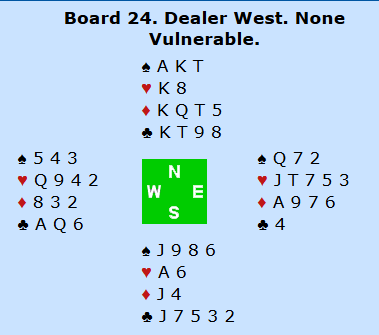
Board 24 featured a classic debate over which game contract to choose. With 25 combined points between North South, 3NT appeared to be the natural destination given both hands were balanced. However, with only four combined hearts between the two hands providing just two stoppers, the defense could easily cash five tricks before declarer was able to establish nine of their own.
Arts | Multon | De Roos | Nowosadzki |
1♦ | P | 1♠ | |
P | 2NT | P | 3NT |
AP |
Nowosadzki raised his partner to 3NT after Multon showed an 18 to 19 balanced hand. On the ♥J lead, Multon won in dummy and immediately played a low club. West took with the ♣A and returned a second heart. Knowing that he could not afford to lose another tempo, Multon's only realistic chance was to hope that clubs broke 2-2 while the ♠Q was onside.
As a result, he cashed the ♣K after his final heart stopper was knocked out. However, the 3-1 club split meant that he was once again down two, just like on the opening board.
Klukowski | De Donder | Kalita | Bahbout |
1♣ | 1♥ | X | |
3♥ | X | P | 4♣ |
P | 4♠ | P | 5♣ |
AP |
De Donder, on the other hand, opened 1♣. After the opponents' overcall and raise, North–South did well to avoid 3NT and instead settle into their nine-card club fit. At the other table, the different opening structure made it impossible for Multon and Nowosadzki to uncover their club fit.
With both club honors favorably placed, declarer only lost the two minor-suit aces and brought home another 11 IMPs.
The Swiss scored 13 IMPs on two subsequent boards, but Belgium continued to cushion their lead.

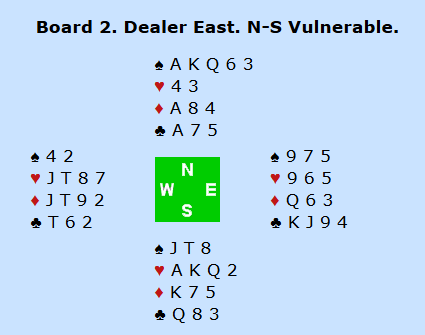
Each side had a long suit available except East, who held a strong notrump type hand. The question, however, was which side had the better chances in a game contract.
4♠ would fail against an ♠A lead followed by another spade, as declarer would still have to lose one spade, one heart, and two club tricks.
Meanwhile, 4♥ also had four potential losers, but it required North to find the unusual play of underleading a diamond on the opening round so that partner could provide a ruff.
Here were the auctions we were presented with:
Klukowski | De Donder | Kalita | Bahbout |
3♠ | |||
P | 4♠ | X | AP |
Here, Klukowski chose to pass his partner's double, knowing that the double in this context was more generic and could simply show values rather than a perfect takeout hand. That was likely why he was reluctant to compete to 5♥.
However, he chose to lead his singleton diamond, allowing North to establish eight diamond tricks. The double dummy line, which could possibly have been found at the table, was to discard a heart on the ♦A, cash the ♥A, ruff a diamond in hand while hoping West did not overruff, ruff South's remaining heart, and then lead a low club to ensure that only two club tricks were lost.
At the other table, Bahbout chose to discard his club loser, likely intending to play for the club honors to be split. He then unblocked the ♥A and ruffed a second diamond, which Kalita covered with one of his honors. Declarer ruffed a heart and played another high diamond. Here, Kalita made the mistake of covering the diamond again. Even though Klukowski overruffed, dummy's remaining trump was now promoted, allowing declarer to cash the fourth round of diamonds without West being able to ruff.
The defensive error allowed the contract to make, and Belgium collected 790.
Arts | Multon | De Roos | Nowosadzki |
3♠ | |||
P | 4♠ | X | P |
5♥ | X | AP |
Here, Arts made the 5♥ bid with his six card suit, and they eventually landed in the doubled contract. On the ♠ lead, Arts immediately won with the ace and played a diamond. Knowing that his partner held a void, Multon correctly played a low diamond from his eight card suit, securing the defense with one trick in each suit.
Belgium still gained 10 IMPs on the board and went on to defeat Switzerland 56–13.


Comments