Riga Round 10: Sweden vs Denmark, Israel vs Poland
This match featured high scoring between the teams. Denmark slightly outlasted Sweden with a close score of 57-51, while Israel dominated Poland with a decisive 58-28 victory. With so many different swings between the teams, we delved into some of them here:

The first swing came on this deal, where everything hinged on locating the missing diamond honor. All four East-West pairs reached 4♥ through an uncontested 2/1 auction, leaving declarer with no additional information about the location of the outstanding high cards.
The board was flat in the Israel–Poland match. At one table, a diamond lead handed declarer the contract immediately, while at the other, declarer simply guessed correctly by playing for the queen to drop. Rafał Jagniewski (Poland) correctly guessed the diamond position despite North already having shown the ♥AQJ and ♣QJ. Unfortunately for Denmark, they guessed the position incorrectly, while Sweden judged it perfectly.
Johan Upmark led the ♣Q after the first round of trumps had been drawn, a play that strongly suggested holding ♣QJ and therefore marked him with 10 high-card points. Hammelev nevertheless chose to take the diamond finesse as a pure guess, perhaps reasoning that Upmark was unlikely to hold additional values. However, because the auction had been completely uncontested, North's first-seat pass conveyed very little about either distribution or high-card strength. In reality, the diamond finesse was essentially a blind guess. When it lost, declarer went down one, costing Denmark 10 IMPs.


This board was pushed in the Israel-Poland match, where NS made a normal 3N+1. In the Sweden-Denmark match, Sweden's Upmark and Nystrom reached a normal 3N+2. The other table is where disaster struck:
O. Rimstedt | de Bilde | M. Rimstedt | Schaltz |
1N | |||
2♣ (majors) | X | XX (escape) | P |
2♥ | P | 2♠ | P |
P | X | AP |
Ouch! West decided to get in the auction by showing the majors after South's 1N opening. Both vulnerable, this was a very risky action, and the consequences showed on this board: With no fit and only 10 points between them, 2♠ doubled was set six tricks, where Denmark picked up 1400 and won 14 IMPs.

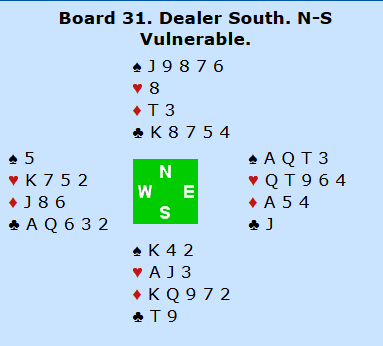
With a long, solid source of tricks in diamonds and a relatively balanced hand, South appears to have a textbook 3NT opening. Playing in notrump is certainly attractive, as a 5♦ contract often depends on avoiding two quick losers in the side suits. On this deal, however, 3NT would have been a poor choice, as the defense could cash five club tricks off the top.
I was taught that light third-seat openings can occasionally steal a partscore or even preempt the opponents out of game. With this hand, the appeal of opening 1♣ is even greater, as it can also serve a lead-directing purpose by suggesting a club lead if the opponents ultimately declare. While opening 1♣ does misrepresent the hand, the potential upside may outweigh the risks. That is exactly the plan the Polish pair attempted to execute at their table.
Gawel | Khutorsky | Jagniewski | Zeitak |
P | P | 1♣ | 3NT |
X | P | 4♣ | P |
P | X | AP |
After partner's double, Jagniewski was afraid of leaving it in since he had significantly fewer high cards than he promised, so he ran to 4♣. Unfortunately, pass would've worked out better than running, since although the opponents would most likely reach a cold 5♦, 4♣X was down 4 for -800.
At the other table, East stayed silent and South opened 3N. Zamir guessed to lead a club, hitting partner's strong suit, so the Polish pair went down in 3N and lost 14 IMPs.
In the other match, Hammelev also opened 1♣, after which NS got to 3N undoubled:
Tylvad | Upmark | Hammelev | Nystrom |
P | P | 1♣ | X |
1♥ (♠) | X | P | 3N |
AP |
Because of the opening bid, Tylvad led a low club, but Hammelev incorrectly judged that since South had bid 3N, he implies a club stopper. So, catering for ♣9xx from partner, Hammelev inserted the ♣8 after declarer played low from dummy. When the surprised declarer won with the ♣9, he took 12 tricks to score +690. It's easy to criticize Hammelev for this play since it didn't work out, but there was lots of reasoning to support his play. It's much harder to defend single dummy than double dummy, and analysis should look at the hand from one player's point of view, not from the double dummy point of view.
The other Danish pair saw de Bilde (North) open his hand a short club, from which they got to 6N:
O. Rimstedt | de Bilde | M. Rimstedt | Schaltz |
P | 1♣ | P | 1♦ |
P | 1N | P | 2♦ |
P | 2♥ | P | 2N |
P | 3N | P | 6N |
AP |
Looking at his solid diamonds, Schaltz decided to take a shot at 6N: maybe it's cold, maybe it's on a finesse, maybe it makes on the wrong lead, maybe it's hopeless. At the end of the day, he just guessed an aggressive action, and likely envisioning a spade lead due to the bidding, even if the defense has two top tricks, they may not find it. Unfortunately, the gamble didn't pay off: 6N is hopeless with only 11 top tricks, and in fact it can go down 4! After East led the ♣K, West decided to just simply beat the contract rather than risking a switch from partner, and he overtook the ♣A and returned a club, setting 6N by one trick. If West had not overtaken, East would probably infer West doesn't have the ♣A and may switch to another suit, which although may not cost on this hand, can very well cost on many others. This crazy board gave 13 IMPs to Sweden.

Curiously enough, both matches had the same contracts. Glancing at this deal, EW are barely out of reach for slam, missing the ♦A and the ♥Q. Let's look at one of the auctions where EW stopped in game:
O. Rimstedt | de Bilde | M. Rimstedt | Schaltz |
P | 1N | P | |
3♠ (6+♦ short ♣) | P | 4♥ | AP |
Pretty normal: East showed his 5-card major despite having a known diamond fit, over which West happily passed with his 3-card support. Slam was possible, but with only an 8-card fit and partner 15-17, West decided it was too ambitious. 4♥ made 4 after South got a spade ruff since EW have entry problems when trying to ruff clubs in dummy. The Polish Gawel-Jagniewski pair also stopped in 4♥.
Now let's look at a table where slam was reached:
Tylvad | Upmark | Hammelev | Nystrom |
P | 1N | P | |
2N | P | 3♣ | P |
3N | P | 4♣ | P |
4♦ | P | 4♥ | P |
5♦ | P | 6♦ | AP |
West's first two actions implied a diamond mild slam interest hand, where Hammelev decided his prime values justified exploring further despite the doubleton diamond. After 4♥ keycard in diamonds, West landed in 6♦. Although all the keycards in diamonds are present, the ♥Q wasn't, so EW were destined to lose a heart for down 1. The Israeli Zamir-Tolenado pair also reached 6♦ down 1. At both tables, the swing was 12 IMPs: Sweden and Poland won those swings.
Overall, slam is a little aggressive but unlucky: If West's ♠Q was in hearts instead, 6♦ would be a great slam.
All tables in both matches featured East playing in 4♥: in both matches, one table made while the other went down. All tables recieved the ♦K lead.
Let's start with Poland's Jagniewski. After winning the lead with his ♦A, he decided to play another diamond to set up the ♦J. This can accomplish two things: either he sets up another diamond trick before crossruffing in spades and clubs, or the defenders break hearts and limit his heart losers to 1. Sometimes, it can even endplay South: If South had the ♣K on this hand (and one less diamond), he would be forced to concede a guess or concede a trick. Note that South opened 1♣ on this hand; thus, declarer did not anticipate the diamond ruff. After the ruff, declarer ruffed out the ♠K and, seeing length in diamonds by South and shortness in diamonds by North, guessed to play the ♥K from dummy, which lost him two tricks and the contract. With the given bidding, his line seems very reasonable: I believe this is the only distribution South can have 5♦ and open 1♣. The other 3 tables had South opening 1♦, alerting EW of the potential ruff.
Next, we have Israel's Toledano. Faced with the danger of a diamond ruff, he decided to draw trumps first: a heart to the ♥K and another heart, where South cashed his 2 heart honors. On the hearts, North pitched the ♦10 a the ♣4 (encouraging?). At this point, South has a tough decision: If he plays a club, declarer could set up the clubs if he has ♣Jx or ♣Jxx, and if he has 3 diamonds as well, partner cannot return a diamond to get the setting trick. However, if he starts with the ♦Q, declarer may pitch a club on the ♦J if he has 4522 shape, and with the ♠K in danger of being ruffing finessed, it is imperative that South returns a club. On the actual deal, South returned the ♠K, giving away the contract. The play looks crazy, but he may have been deceived by his partner: if the ♣4 was actually discouraging, South could imagine the clubs being running and thinking that a cashing spade was the only chance. Nevertheless, one of the defenders is to blame here, and Israel walked away with 10 tricks and 10 IMPs. (Also, North probably didn't pitch a spade because of South's failure to make a support double, which would imply declarer has 5. However, the ♦10 is an important communication card, so maybe letting go of a spade was worth the risk.)
In the other table, Sweden's Mikael Rimstedt declared the hand. He tried to set up clubs, using dummy as the master hand and hoping clubs were 4-3. Unfortunately, after clubs were 5-2, declarer was backed into the spade finesse: once that lost, the contract went for down 1. A reasonable line of play, as the contract looks good if clubs are 4-3, which is the most likely outcome. Unfortunately, the cards were stacked against him on this deal.
Finally, we have Denmark's Hammelev. He opted to ruff spades in dummy: after leading a heart to the ♥K, he ruffed 2 spades in dummy. Once the ♠K fell, declarer was home: he just lost 2 hearts and 1 diamond. 10 IMPs to Denmark.
So which line of play do you think is the best? Personally, it's tough and very dependent on the bidding: Hammelev had the help of a support double from South in spades, and with his opening hand strength, made it very likely he had one of the black kings, in which his line was very good. However, without the support double, Rimstedt's line seems great: all he needs are clubs 4-3. Without the diamond opening, playing a second diamond also seems like a good line. The bidding influenced the declarers' play, where different actions from opponents make the probabilities of each line succeeding different. The lesson of the deal: pay attention to the bidding when declaring: it may make some lines stand out over others.


Comments