Riga Round 11: Netherlands vs Germany (LB), Italy vs Norway (BBO), Switzerland vs Romania (BBO)
Watching this round from my end, one thing immediately caught my attention: the sheer number of slam decisions. It felt like it was slam after slam after slam. Even more remarkably, many of them were extremely thin and had to be judged in the face of fierce competition from the opponents.
Let's take a look at the successes and disappointments of the slam bidding throughout the round.

Italy vs Norway:
Closed room
Gerli | Bakke | Manno | Brogeland |
P | 1♣ | 1♥ | |
2♥ (1) | 2♠ | P | 3♥ |
X | P | 4♣ | P |
5♣ | AP |
Spades
Open Room
Helgemo | Donati | Heiberg-Evenstad | Percario |
1♦ | 2♣ | X | |
2♦ | P | 3♠ | P |
4♠ | P | 5♥ | P |
6♣ | AP |
Even without an opening bid from North, the Italians still managed to scramble into 5♣ as Brogeland and Bakke bid out their heart fit. Manno’s 4♣ bid likely showed club length; otherwise he might have chosen 3♠, especially after earlier bidding suggested limited spade support. His failure to act over 2♠ the first time also points away from spade support, reinforcing that interpretation.
In retrospect, a 4♥ cue-bid over 4♣ might have helped clarify values and improve their chances of reaching a thin slam.
In the open room, 1♦ was opened, but East–West were soon able to locate their enormous club fit. With Nicolai Heiberg-Evenstad’s splinter, they were guided into a slam.
The meaning of the 4♠ bid is unclear, though it may have been used as a form of keycard ask, consistent with a 5♥ response showing two keycards with the trump queen.
On the heart lead, dummy’s ace took the first trick, and declarer immediately began establishing spades, discarding a heart on the ace of spades. He then shifted into a cross-ruff between spades and diamonds. Once the king of spades fell, twelve tricks were effectively secured. A well earned 11 IMPs to the Norwegians.
In the Netherlands vs Germany match, Bauke Muller and Simon de Wijs navigated a relay sequence after a Precision 2♣ opening to reach a cold slam. At the other table, Joris van Lankveld also opened 2♣ with the North hand, showing either a weak two in diamonds or a strong hand depending on the structure.
The German pair, in contrast, stopped in a straightforward 5♣ contract, resulting in an 11 IMP swing to the Dutch. It was a curious coincidence that both Dutch players sitting in different rooms ended up starting with the same opening bid.
The Swiss ended up capturing 11 IMPs on this hand, but not in the fashion as the two matches above. Klukowski and Kalita did indeed fail to reach the marginal slam, collecting 440 as they took all the tricks in 5♣. However, the Romanians steered the wrong way in which contract they wanted to land in:
Negoescu | Multon | Georgescu | Zimmermann |
P | 1♣ | 1♥ | |
1♠ | 2♣ | P | 2♥ |
4♠ | AP |
After a fairly ordinary start to the auction, Negoescu jumped to 4♠ over the 2♥ bid, effectively shutting down the auction before East–West had fully uncovered their club fit. Playing in a 6–0 fit made three trump losers inevitable given South’s spade holding, along with a further loser in the heart suit. While the defense could theoretically have found a club ruff to set the contract by two, declarer still managed to take nine tricks.
The 4♠ bid was certainly rushed and unnecessary, but East-West could have simplified matters by doubling 2♣ to show club length, if that option was available in their system. Had West chosen a different action, such as doubling or bidding 3♥, they might have navigated more comfortably into their club fit and reached a safer partial contract. Playing transfers over overcalls on this hand might also have helped. A transfer-style bid from West showing 6+♠ and constructive values would have described the hand more precisely in a single call, making a subsequent double more accessible. In contrast, a direct 1♠ response would likely have been more ambiguous in both length and strength.

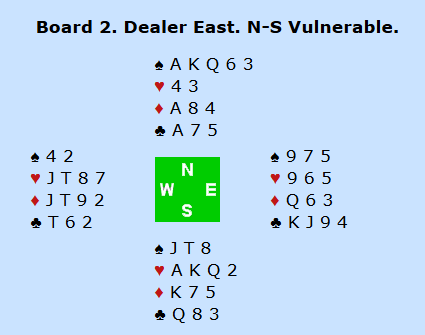
This hand featured a slam that would be cold with either the ace of diamonds or the queen of clubs onside. Most auctions started this way:
West | North | East | South |
1♥ | |||
1♠ | 2NT |
Norway and Switzerland both picked up 11 IMPs as their counterparts landed in the slam through their complex auction and went down by either attempting to finesse the diamond ace or the club queen. Below were the auctions that landed them in slam:
Helgemo | Donati | Heiberg-Evenstad | Percario |
1♥ | |||
1♠ | 2NT | P | 3♣ |
P | 3♠ | X | 3NT |
P | 4♣ | P | 4♦ |
P | 4NT | P | 5♣ |
P | 6♥ | AP |
Klukowski | Bacalu | Kalita | Calipetre |
1♥ | |||
1♠ | 2NT | 3♠ | 4♣ |
P | 4NT | P | 5♣ |
P | 6♥ | AP |
Both the Dutch and the Germans reached 6♥ on this deal, yet it still produced a 14 IMP swing. Unfortunately for Simon de Wijs (Netherlands), he chose a club lead from the West hand, immediately gifting declarer three club tricks. That allowed declarer to discard both diamond losers on the established clubs, making the slam straightforward.

Not long later, another attractive-looking slam opportunity arose. Although the diamond fit was somewhat hollow, spades was clearly the superior strain. In 6♠, declarer can establish the long diamond suit and eventually discard the heart losers.
The success of the slam, however, depends entirely on who declares it. If West is declarer, a heart lead from North immediately defeats the contract by establishing an unavoidable heart loser to go with the inevitable diamond loser. If East declares instead, the heart holding is protected from the opening lead, giving declarer enough time to establish the diamonds and dispose of the losing hearts.
But how easy is it to reach this slam?
Italy vs Norway
Gerli | Bakke | Manno | Brogeland |
P | P | P | |
1♦ | P | 1♥ | P |
1NT | P | 2♣ | X |
2♠ | P | 3♠ | P |
4♠ | AP |
After the artificial 1NT response, the Italians showed little interest in exploring for slam. Once they discovered the 4–4 spade fit, they abandoned any further investigation and settled comfortably in 4♠.
Here's how it went at the other table:
Helgemo | Donati | Heiberg-Evenstad | Percario |
P | 1♦ | P | |
1♠ | P | 2♠ | P |
2NT | P | 3♠ | P |
3NT | P | 4♥ | P |
4NT | P | 5♦ | P |
5♥ | P | 6♣ | P |
6♠ | AP |
Conversely, Nicolai Heiberg-Evenstad opened the East hand, allowing Helgemo to take charge of the slam exploration. The final contract was still wrong-sided, leaving North on lead. However, with the 4♥ cue-bid showing heart control, a heart lead was unlikely to be high on Donati's list of options, and he instead chose a club.
It is also worth noting that the final 6♣ bid by East did not promise the ♣K, making the club lead appear even more attractive from the defenders' perspective.
The board was flat in the Switzerland–Romania match. Although the two pairs reached the slam through different auctions, both North players found the same club opening lead, allowing the contract to make comfortably.
Netherlands vs Germany:
De Wijs | Gruenke | Muller | Boecker |
P | 1NT | P | |
2♣ | P | 2♥ | P |
3♦ | P | 3♠ | P |
4♣ | P | 4♥ | P |
4NT | P | 5♣ | P |
5♦ | P | 5NT | P |
6♠ | AP |
The weak 1NT opening enabled them to right-side the slam, as the East hand showed both majors during the auction. South led a diamond, making the contract essentially a laydown once trumps broke 3–2.
Schwerdt | Van den Bos | Linde | Van Lankveld |
P | 1♦ | P | |
2♦ | P | 2NT | P |
4♦ | P | 4♥ | P |
4♠ | P | 5♣ | P |
6♦ | AP |
The Germans ended up playing in their diamond fit, where they lacked the entries to discard their losers. Joris van Lankveld also led a diamond on this hand, which was won by dummy, and another diamond was played. Van den Bos won with his king but made a play on the next trick that ruined their opportunity to defeat the slam. By returning a third diamond, he ended up squeezing his partner in hearts and clubs. Declarer then ran the remaining diamonds and spades, ultimately arriving at this position by trick 10.

Pitching a heart meant that dummy's heart would become a winner, while pitching a club would set up declarer's club suit. Kudos to the German declarer, who turned what could have been a 14-IMP loss on the board into a mere 2-IMP loss.

Well, here we go again with another one of these wild distributions. An 8–5 shape in the West hand is absolutely crazy. Let's see how the bidding developed across the different matches.
Switzerland vs Romania:
This contained the least of the swings
Negoescu | Multon | Georgescu | Zimmermann |
1♦ | |||
6♠ | P | P | X |
AP |
This board featured the smallest of the swings. Here, West simply overcalled 6♠, likely in the faint hope that it would make. Although 11 tricks were available to the offense, Negoescu went down two, though it wasn't clear from the Vugraph where he went wrong.
The other table landed in the same contract, but only went -1 for 7 IMPs for the Swiss.
Klukowski | Bacalu | Kalita | Calipetre |
1♦ | |||
2♦ | 5♦ | P | 6♦ |
6♠ | X | AP |
Netherlands vs Germany:
De Wijs | Gruenke | Muller | Boecker |
1♦ | |||
4♠ | 4NT | P | 5NT |
6♥ | X | 6♠ | X |
AP |
The par score was achieved in this room. Meanwhile:
Schwerdt | Van den Bos | Linde | Van Lankveld |
1♦ | |||
4♠ | 5♦ | P | P |
5♠ | P | P | X |
AP |
Believe it or not, this result was replicated at 8 out of the 30 tables. However, the Germans stole 14 IMPs by correctly maneuvering the contract to make it.
And if you thought that would be the biggest swing of the day, you are in for a treat. The matches between Austria and Lithuania as well as Iceland and Croatia produced a board-high 19 IMPs, while the Norwegians also bolstered their lead:
Helgemo | Donati | Heiberg-Evenstad | Percario |
1♦ | |||
4♠ | 5♦ | P | P |
5♥ | P | 5♠ | 6♣ |
P | 6♦ | P | P |
6♠ | P | P | X |
AP |
A wild rollercoaster ultimately ended after Helgemo took the 6♠ sacrifice, paying only minus-200 to the Italians here.
Gerli | Bakke | Manno | Brogeland |
1♦ | |||
2NT (1) | 5♦ | P | P |
5♠ | P | P | 6♦ |
X | AP |
Majors
The Norwegians initially stopped in game; however, Gerli competed to 5♠, holding no cards in either minor suit. Consequently, this pushed Brogeland to bid 6♦, which was doubled by Gerli. This bid may have been intended to ask partner to sacrifice, but it certainly wasn't clear for the East hand to do so given their defensive potential. With the diamond hook working, the Norwegians made their contract for +1540 and 16 IMPs.
All in all, this set brought plenty of excitement, with IMPs swinging on numerous boards. While there were several other thrilling hands, it would take far too long to list them all here. Below are the final match scores:
77–22 in favor of Norway
73–3 with Switzerland on top
54–48 as Germany squeaked out a close win


Comments