Riga Round 13: Israel v Denmark

Unfortunately, there seemed to be only 1 vugraph match this round, featuring a 18-62 victory for Denmark. Nevertheless, there are still some surprises in this match to delve into.
Board 10

Fascinating hand: EW have the majority of the strength but can't make any game, while NS make 5S with their mere 17 HCP. Let's take a look at the auction at the Danish EW's table:
West (Schaltz) | North (Khutorsky) | East (de Bilde) | South (Zeitak) |
1C | 1S | ||
X | 4S | 5C | All Pass |
A popular saying in bridge is, "5 level belongs to the opponents". This is meant to be a guideline to high level competitive bidding: 5 over 5 is very risky since the amount of tricks that must be taken is very high for both sides. Far too many times both sides will be down one or two tricks, costing several IMPs per board. This is the wisdom that I have learned bridge with, and it points to NS's decision to pass out 5C. With a flat hand, South certainly doesn't have justification to bid, and by bidding 4S, North has made the opponents guess. Another piece of wisdom is to not let your side make the last guess; hence, North passed and hoped EW have guessed incorrectly.
5C ended up down 2 tricks for EW, losing a spade, two hearts, and a diamond. The auction at the other table was very similar except for one decision at the end:
West (Slivovich) | North (Hammelev) | East (Sabbah) | South (Tylvad) |
1C | 1S | ||
X | 4S | 5C | P |
P | 5S | X | All Pass |
Seeing his club void and the 10-card spade fit for his side, Hammelev judged that both sides had a huge fit. So, not knowing if 5S was making or a good save, he decided to break the "rule" of not bidding 5 over 5 and bid 5S. Indeed, rules are meant to be broken: with his distribution and fit for partner, it's easy to see why he would want to bid. If the red suit finesses are onside, he may make; if they are offside, 5C may make. Yes, sometimes both contracts will be down 1, but at IMPs, as long as this probability isn't too large, it's a risk that must be taken. The potential for winning lots of IMPs in other occasions outweighs the downsides.
East reasonably doubled, believing NS to be saving over 5C. Unfortunately, 5S was cold: Tylvad just set up a third heart to pitch a diamond and took the diamond finesse, losing only to the two red aces. 5S doubled made and gave 12 IMPs to Denmark.
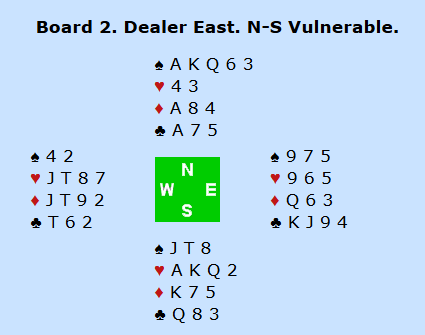
Board 12

Another intriguing hand that really captures the modern style of bridge in the bidding. Despite only holding 5 spades, the concensus among pros is to open the West hand 2S. The favorable vulnerability at first seat and the potential to block the opponents' hearts is too lucrative. 5-card preempts when favorable are becoming close to the norm in bidding, and it can work wonders:
West (Schaltz) | North (Khutorsky) | East (de Bilde) | South (Zeitak) |
2S | P | 2N | P |
3D | P | 3S | All Pass |
After West's 2S bid, Khutorsky didn't feel like his hand was strong enough for a takeout double. With only 11 points and a takeout double forcing their side to the 3-level, not to mention the fact that they're vulnerable, it's easy to see how the double can be very risky: if East has a good hand, NS may go down in their 3-level partscore several tricks, which is a bad score even undoubled. Whatever 3D showed, East was unhappy to hear it: he signed off in 3S, where EW made even after misguessing the jack of diamonds. +140 for Denmark, but more importantly, NS were blocked from reaching their 4H game, which was making on this layout.
West (Slivovich) | North (Hammelev) | East (Sabbah) | South (Tylvad) |
2S | X | 3S | 4H |
All Pass |
At the other table, Hammelev doubled: although risky for the reasons mentioned above, there are many reasons to double. With shortness in spades, partner is likely to have length in spades and therefore will be unable to balance, even with a decent hand. So, double will allow NS to find game in those situations. Also, double could land NS in the right partscore: if partner has 4 hearts, 3H and 2S could easily both be making.
The double paid off on this deal: Tylvad had an obvious 4H bid, which made after declarer pitched a diamond on a good club. +620 and +13 IMPs to Denmark.
Board 13

The Israeli Khutorsky-Zeitak pair landed safely in 3N by South, in which declarer had 11 top tricks, making 5. The other table, however is where it gets wild: even looking at the final contract, you know disaster struck for one side.
West (Slivovich) | North (Hammelev) | East (Sabbah) | South (Tylvad) |
P | P | 1C | |
1D | 1S (no 4M) | P | 2D |
P | 2S | X | XX |
All Pass |
Yes, NS landed in 2S redoubled! 2S most likely showed values in spades, information that partner could desperately need when searching for notrump. East's double was meant to imply he had spades: maybe EW could still compete for the partscore. However, South's redouble changed everything: it was clearly meant to play. East now had a choice: he could run to the 5-3 diamond fit, which was likely going to get doubled and beaten several tricks, or he could stand his ground and defend with 6 spades against a 2S contract. Seeing that 3D would result in an almost guaranteed disaster and 2Sxx may benefit his side if he could beat it, Sabbah took his chances and passed it out. He was most likely expecting more from Slivovich's 1D overcall vulnerable, though with such a good diamond suit, it's hard to pass.
After ruffing 2 diamonds in his own hand and cashing 2 spades, Tylvad just ran their side suit winners. Not having a diamond to return, East could only get 4 spade tricks. 2Sxx+1 netted +1240 for the Danish team (bet you didn't know that!). 11 IMPs to Denmark.
Conclusion
Only one match today since I couldn't find more in the archives. Sorry about that, hopefully the vugraph archives will contain more than one match in the next few rounds. Even with just one match, it was very exciting: we saw a 5-over-5, a 5-card preempt, and a redoubled contract in the same set! Hopefully the remaining matches are as exciting as this one.


Comments