Riga Round 18: Switzerland v Italy

Switzerland won this tight round 33-27.
Board 18

Let's look at the Italian NS table first:
West (Klukowski) | North (Sementa) | East (Kalita) | South (Versace) |
P | P | ||
1D | 1S | X | 4S |
P | P | 5D | All Pass |
The auction feels fairly normal: NS did a good job of forcing EW to guess. East could've doubled, but since their side had a diamond fit (1D showed 4+), he opted for a 5D bid instead. Additionally, East's defensive values are soft, meaning 4S doubled could make, especially given that Versace bid 4S unfavorable.
The play was fairly simple as well: after Sementa cashed his two black suit aces, declarer ruffed 2 spades in dummy, drew trumps, and pitched 2 hearts on the KQ of clubs. Making 5. Note that not cashing the black suit aces doesn't make a difference on this deal: declarer can always ruff 2 spades, and he can lead a club out of his hand, catching North in a Morton's fork. If he takes the ace, the KQ can discard 2 hearts; otherwise, West can just concede a heart.
At the other table, the auction was the same up until the end:
West (Percario) | North (Multon) | East (Donati) | South (Zimmermann) |
P | P | ||
1D | 1S | X | 4S |
P | P | X | P |
5H | X | All Pass |
Donati chose to double instead of bidding 4S. If partner has high cards in spades, their side could easily profit from doubling 4S and beating it, while those cards would be wasted if EW were declaring. With the opponents unfavorable, Donati catered for partner passing 4S doubled, where beating it by 2 tricks would be a profitable result. Percario, with 4 card heart support, bid 5H and played there.
It seems like declarer just has to guess where the HQ is, losing only the two black suit aces. And with the double by Multon, it seems like he has just given away the contract. However, 5H is actually unmakeable on the right defense. Indeed, NS can force dummy to ruff twice in spades so declarer can't pick up North's HQ.
Multon started with the SA and another spade, forcing dummy to ruff. Declarer crossed to his hand with a diamond and played a heart to the J, which stood. He then crossed with a diamond and ruffed his losing spade in dummy. When hearts broke 4-1, declarer was down 1.
Why didn't declarer finesse again? Well, he only has 10 tricks: 5 hearts (including a spade ruff) and 5 diamonds. the KQ of clubs would be his 11th trick, but when the defense won the CA, they would return another spade, forcing dummy to ruff and giving them a guaranteed heart trick. So, declarer's only hope was that Multon doubled with Qxx of hearts. Great defense from Switzerland, giving them 11 IMPs on this board.
Next up, a pair of hands that effectively canceled each other out. It's quite poetic that these hands were only 2 boards apart. These hands illustrate the difficult decision between 3N and 5m: in this case, 3N or 5C?
Board 22

First, the Italian auction, which reached 3N with the EW cards:
West (Percario) | North (Multon) | East (Donati) | South (Zimmermann) |
P | P | ||
1N | P | 2C | P |
2D | P | 3S | P |
3N | All Pass |
2D showed either no 4M and a minimum or 4S without 4H and a maximum. East's 3S looks like a splinter bid with tolerance for both minors. West, with 5 spades, decided that 3N was the best contract rather than 5C. Note that many pairs play 1N-3S as game forcing 1=3=5=4 or 1=3=4=5. The East hand is a perfect bid to use this convention. Not like it would save EW from 3N anyways, since West would probably bid 3N regardless.
On the SQ lead (K would be power lead), declarer had only 7 tricks even if the diamonds came in. Percario had to hope to set up clubs for more tricks. After winning the ace, declarer cashed 2 diamonds and finessed a club, losing to South. 3 more spade tricks and the HA made the contract down 1. Perhaps Percario could've saw the spades running from his partner's shortness, but with 5 spades, that's probably not enough to directly set 3N. Besides, with just a little help from partner (even stiff 8 could work), spades could be a dead suit for the opponents. There are just very few hands where EW can take 11 tricks in a 4-4 club fit, hence why Percario and most pros prefer 3N over 5m in general.
I wouldn't be writing this if the other table reached 3N as well:
West (Klukowski) | North (Sementa) | East (Kalita) | South (Versace) |
P | P | ||
1S | P | 1N | P |
2C | P | 3C | P |
3N | P | 4C | P |
5C | All Pass |
Klukowski decided to open 1S instead of 1N with his 5-4 shape. Although he has lots of values in the red suits, showing the 5-4 distribution has upsides as well, such as finding a cold 5C when 3N is down. EW do not play gazilli, and East could've bid 2D to show a better raise. Kalita smartly decided to pull 3N out to 4C, reasoning that EW can't take that many club tricks, so they will probably have to lose the lead in order to set up their tricks. This gives the defense a good chance to run a major suit, which can be prevented if their side makes 5C. He viewed his partner's hand to be more shapely, and thus reasoned that ruffing spades may raise the total to 11 tricks.
In 5C, a club lead was won by the CK in South, who then cashed the HA. These were the only tricks the defense got: with diamonds running (and declarer can ruff a diamond if they're not), Klukowski comfortably made 5C for +600 and 12 IMPs to Switzerland.
Board 24
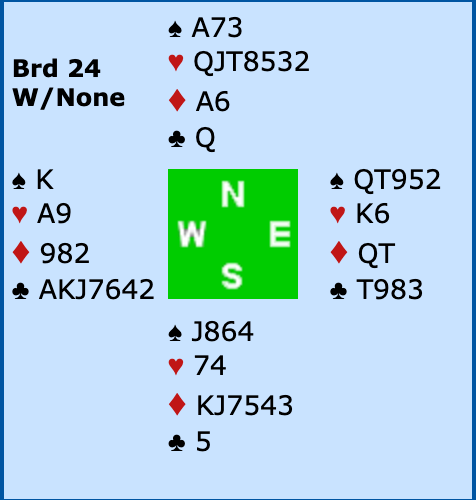
Just 2 boards later, another 3N or 5C decision appears. This time, EW have 11 clubs instead of 8, but 3N from West is the right decision. North would never find the diamond lead unless partner bid them, and 3N would make with 9 top tricks.
The Italians, who are in 3N again:
West (Percario) | North (Multon) | East (Donati) | South (Zimmermann) |
1C | 1H | X | P |
2H | 3H | P | P |
3N | All Pass |
1C was 2+, and double showed 4-5 spades (or maybe 4+). The HQ is the natural lead from the North hand, but it unfortunately wasn't the correct one on this deal. Declarer quickly claimed 9 tricks (2 hearts, 7 clubs) for +400. Now, the Swiss, who are in 5C again:
West (Klukowski) | North (Sementa) | East (Kalita) | South (Versace) |
1C | 1H | X | 2D |
3C | 3H | 4C | P |
5C | All Pass |
1C was polish club, and X was again 4-5 spades. 3C showed 15+ with a club suit, and 4C was competitive. Klukowski made a reasonable shot at 5C: it would've made if the DK and DQ were interchanged.
Unfortunately, even with a heart lead, declarer was doomed to lose 2 diamonds and a spade. Down 1 and 10 IMPs to Italy.
3N or 5m decisions are always hard: In general, only look for 5C when one side has an unbalanced hand: if both sides are balanced, if a suit runs in 3N, the defense will take 2 tricks against 5m, making it very hard to make regardless. Both these hands were unbalanced, but one worked while the other didn't. In the end, it all canceled out: both sides got a swing.


Comments