Riga Round 19: Bulgaria v Netherlands and Germany v Sweden

With so many swings this round, and most of them overlapping between the two matches, I would like to analyze the interesting boards for both matches at the same time rather than separately. Bulgaria lost 6-82 and Germany won 62-50.
Board 3

Clearly, EW are destined for a major suit game. But which one? As it turns out, because of the heart ruff, 4S is down 1 while 4H makes. Although it seems like hearts are better, it's very easy for West to insist on spades being trump, which isn't a bad decision since his spades are so solid.
Let's take a look at the pairs which reached 4S first: Bulgaria's Draganov-Nanev and Sweden's Bertheau-Hult.
West (Draganov) | North (De Wijs) | East (Nanev) | South (Muller) |
1D (2+) | |||
3S | P | 4H | P |
4S | All Pass |
Holding such a strong hand with a great heart suit, Nanev wanted to take a shot at 4H with his 7-bagger. However, with great spades, Draganov corrected to 4S despite holding doubleton heart support. From his perspective, his spades would be useless in 4H since he had no entry, while partner had the strong hand and the heart suit might be useful in 4S. Overall a reasonable bid that didn't work out on this board.
West (Bertheau) | North (Fritsche) | East (Hult) | South (Reps) |
1C (short?) | |||
4S | All Pass |
Bertheau decided to just bid 4S with his excellent suit. This may make the opponents guess incorrectly, or it could actually make if partner has the right cards. Partner did almost have the right cards on this deal: it's just the heart ruff that beats it. However, the unfavorable vulnerability makes it dangerous: even down 2 is a bad score.
Next up, the tables that did manage to reach 4H: Netherlands' Nijseen-van de Pav and Germany's Boecker-Gruenke. Both had identical auctions:
West (Nijseen/Boecker) | North (Marashev/Upmark) | East (van de Pav/Gruenke) | South (Tsonchev/Nystrom) |
1D (short) | |||
3S | P | 4H | All Pass |
With 2-card heart support, both pairs were content to play in 4H despite the spades being useless. If partner does have spade shortness, he will already expect the spades to be dead, so this may not be new information. If partner thinks he can make 4H, the West hand has 2-card support, ruffing potential, and the DK behind opener - what more can you ask for? 4H by East is cold after ruffing a club in dummy and seeing the HJ fall. 12 IMPs to Netherlands and Germany.
Board 13
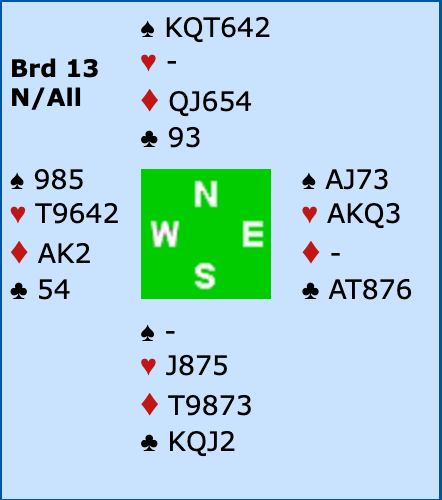
It's easy to get excited with the EW hands, since both of their hands contain prime values for their partner. However, the bad trump break and black suit holes make even 5H unmakeable.
Two of our tables reached the unlucky 6H: Bulgaria and Sweden. Let's see how the bidding went for them:
West (Draganov) | North (De Wijs) | East (Nanev) | South (Muller) |
3S | 5N | P | |
6H | All Pass |
Nanev's 5N bid over 3S feels a little aggressive: clubs in particular can produce many losers. However, it's easy to see why he bid it, and how it could work: with 4 spades, partner is likely short in spades. If EW have a club or heart fit, and partner has a singleton spade (which isn't all that unlikely), slam could easily be cold. In fact, why does West have to have all his points in diamonds on this hand? With the KQ of clubs instead of the AK of diamonds, 6H has great chances. Nanev's other options are 3N and double, but both are flawed. If Nanev bids 3N, partner will pass when slam is cold very often. The defense also might run a bunch of diamond tricks. If he doubles, how will he continue over 4D, 4H, or 5D? Nanev knew that Bulgaria was trailing in the match, so he made an aggressive and conceivable bid that didn't work out.
Our other 6H was doubled, and the auction was far more complex:
West (Bertheau) | North (Fritsche) | East (Hult) | South (Reps) |
2S (S + minor) | X | XX (pick minor) | |
3H | P | 3S | 4C (pick minor) |
P | 4D | 6H | X |
All Pass |
2S was spades and a minor, which can be 5-4 but is usually 5-5 vulnerable. With 6-5 shape, even playing this convention, 3S still might be better since it puts more pressure on the opponents and gives them less room. However, the spades aren't that good and the diamonds are reasonable enough to not ignore them: it's about pressure vs science. Once North shows diamonds, Hult's hand becomes much better with the diamond void. With no scientific way of bidding the hand, he took a leap of faith and jumped to 6H, very reasonable given Bertheau's 3H free bid showing values and the void in the opponents' suit. Unfortunately, knowing EW had nowhere to run, Reps doubled them and picked up 500.
The German East player Gruenke was actually in a non-heart contract on this board: he took one of "Nanev's other options".
West (Boecker) | North (Upmark) | East (Gruenke) | South (Nystrom) |
3S | 3N | All Pass |
3N is very reasonable as well: with 18 HCP and spades double stopped, 3N seems like the most descriptive bid. Although the diamond void is concerning, 3N is the least of the evils: with a good hand, partner can continue on, and NS aren't likely to have a huge diamond fit with all the high cards. Odds are, partner can provide a stopper in diamonds. And he did on this board: on the CQ lead, 3N made after declarer set up clubs. +15 IMPs to Germany.
Is system on over 3N? It's an important discussion to have with your partner. Are 4D and 4H still transfers, is 4C still stayman, etc. These are all questions that aren't considered enough because the direct natural 3N bid is rare. However, if one person believes 4H shows spades while the other believes it's hearts, that's a big disaster.
Anyways, our final East, van de Pav, chooses yet another option.
West (Nijssen) | North (Marashev) | East (van de Pav) | South (Tsonchev) |
3S | X | P | |
4H | All Pass |
Double has clear advantages: it introduces hearts and clubs as playable strains, and it can help reach slams that wouldn't be reached with a 3N bid. If West bid diamonds, East could respond with notrump with his double spade stopper. Over 4H, although having a great hand, van de Pav smartly judged to pass: partner's 4H didn't show extra value, and going beyond 4 was risky. 4H made and gave Netherlands 13 IMPs.
Board 15

Three tables ended up in 4S by East, while the other was in 3S. 2 tables made 9 tricks and the other 2 made 10. Let's look at the hand.
In the Bulgaria-Netherlands match, both tables opened the West hand and recieved a natural 2D overcall, and both Souths led a diamond.
Firstly, the Bulgarian declarer. After cashing the AK of diamonds, De Wijs returned returned her singleton heart, won in dummy by the Q. Declarer was now in danger of losing 2 diamonds and 2 hearts, even with both black suit finesses onside. East tried to ruff the 4th heart in dummy: he ran the CQ, finessed a spade, cashed the CA and SA, then played a heart to the A.
North now stopped to think: partner led the D2, implying he had 3 of them. Since declarer didn't finesse clubs again, he only has Ax of clubs. So, declarer's exact distribution must be 5=4=2=2, meaning if North ruffed in, they would either have to concede a ruff and sluff (if diamond return) or set up dummy's clubs (if CK return). The only chance to beat the contract was to pitch a diamond on the HA! De Wijs pitched a diamond, and declarer had to either concede 2 hearts if he draws trumps, or will lose a heart and the SQ. When declarer played the third heart from dummy, Muller won and returned a 4th heart, allowing the defenders to score the SQ for down 1.
Declarer's line works when the SQ and CK are onside, and either hearts 3-3 or North has Qx of spades and 4+ hearts. North wouldn't shift to the HJ if he had the king. So, that gives him a high probability of holding both black suit honors since North overcalled 2D unfavorable over a mini 1N opening. The line isn't bad and it's the most intuitive line, but East could've picked up some warning signs. After the CA holds and no K appears, East can count North with having most likely at least 6-3 in the minors, meaning he has at most 4 cards in the majors. Since North must have at least Qx in spades, he has at most 2 hearts, making the line illegitimate. However, it's hard to come up with another line, and 5-3 is unlikely but not entirely impossible. The Dutch declarer, however, started with a different plan.
Van de Pav had the same first 3 tricks, but instead of trying to ruff hearts in dummy, he wanted to pitch them on the clubs. He also ran the CQ, but continued another club to the A and played the SJ! This concedes a spade trick, but it creates a vital second entry for the club suit. When North won the SQ and returned another spade, declarer won it in dummy and ruffed out North's CK. He then drew trumps and crossed to the HA, throwing 2 hearts on 2 clubs and making 4, losing a spade and 2 diamonds. Made 4 and 10 IMPs to Netherlands.
The German declarer Gruenke had an almost identical line, but instead of exiting with the SJ, he played the SA and another spade, intending on finessing South's 9. These are identical except when a player has singleton Q, in which case Gruenke makes an overtrick. If the SQ had been ducked, van de Pav would have to finesse the S9 anyways. The Germans also opened the West hand a mini NT, but did not recieve any interference.
Finally, the Swedish table. The West hand passed, and North opened 1D. With only 24 points between them and no one having great shape, they stopped in 3S and took a safer route of making 9 tricks: cash AK of spades and CA, then concede a club to the K. As long as clubs weren't Kx for North, the contract was secure. Becaused the Swedes missed game, Germany picked up 7 IMPs.
So which line is better: clubs or hearts? I don't know, but clubs worked on this hand when hearts didn't. Also, after the second club, it wasn't too late to try a low spade, hoping to finesse South's 9. Underleading a spade is tricky since it gives away a winner, but it's necessary for the entries. It just depends on how declarer reads North's shape: to me, clubs feels more likely, but that's in postmortem and I'm probably biased by the results.


Comments