Round 21: Sweden vs Switzerland
These two teams met last year in the quarterfinals of the Bermuda Bowl. Sweden destroyed the Swiss hopes of winning three consecutive titles in that event. Will the tables have turned this time around though?

Klukowski | O. Rimstedt | Kalita | M. Rimstedt |
P | |||
P | P | 1NT | P |
2♦ | P | 2♥ | P |
2♠ (1) | P | 2NT | AP |
Invitational with 5 hearts
Jacek Kalita declined the game try made in this room, despite holding three card support. His hand was likely more suitable for no trump, but perhaps that option could have gone wrong had partner held a doubleton in one of the minor suits. A queen of clubs lead would defeat the contract by at least one trick, as the defense could take four club tricks, two heart tricks, and a spade trick if they defended perfectly.
However, the rather normal jack of spades lead was chosen instead, and Kalita still made the contract despite the defense taking three spade tricks. That resulted in a score of plus one hundred and twenty for the Swiss pair.
Bertheau | Multon | Hult | Nowosadzki |
P | |||
P | P | 1NT | P |
2♦ | P | 2♥ | P |
2♠ | P | 3♥ | AP |
The Swedes retreated to 3♥ after Hult declined the invitation. Michal Nowosadzki led the ♦10, which was won by dummy's ace, and declarer proceeded to draw trumps. Later in the play, Nowosadzki did well to discard a club, avoiding a potential endplay later in the hand.


Long suits once again. The first question is what to open with the West hand in standard. Opening 1 spade could be too conserative of a move, but what would you rebid after a strong 2 clubs opening? You do have 22-24 balanced but partner might not imagine you with this shape. Let's look at how both tables handled these auctions.
Bertheau | Multon | Hult | Nowosadzki |
2♦ (1) | 3♦ | P | P |
3♠ | P | 4♥ | AP |
Any GF or 22-24 balanced
Over the 3♦ overcall, Peter Bertheau chose the straightforward 3♠ bid rather than doubling. With North–South unfavorable, partner was unlikely to convert a takeout double for penalties. An additional advantage of bidding 3♠ was that Bertheau could comfortably pass 4♥, knowing it was likely the partnership's best game contract. North's pass over 3♦ also likely showed a very weak hand.
After leading the ♦A, Nowosadzki immediately switched to a spade. Declarer won the ♠A, cashed the ♥A, and then played three rounds of clubs, discarding the diamond loser on the third club. Simon Hult then found the key play by pitching his spade loser on the fourth club, allowing South to win the trick.
This was a textbook avoidance play. Had declarer instead drawn trumps immediately after discarding the diamond, the defense would have scored an uppercut in the diamond suit.
The other room took a slightly different turn in the bidding:
Klukowski | O. Rimstedt | Kalita | M. Rimstedt |
1♣ | 3♦ | P | P |
X | P | 4♥ | P |
4♠ | AP |
11-14 balanced or natural, 15+ with clubs, or any 18+
Klukowski chose the ambitious route of doubling, hoping to penalize the opponents. The plan ultimately backfired, however, as he was unable to judge whether hearts or spades was the better strain. He eventually corrected to 4♠, where the partnership took only eight tricks.
A balancing 3♠ bid with his hand would still have shown the strong variety of the Polish Club opening, although Kalita may genuinely have held a long heart suit when he bid 4♥. In hindsight, bidding 3♠ immediately would likely have kept the partnership out of the wrong game. Sweden gained 11 IMPs on this hand.

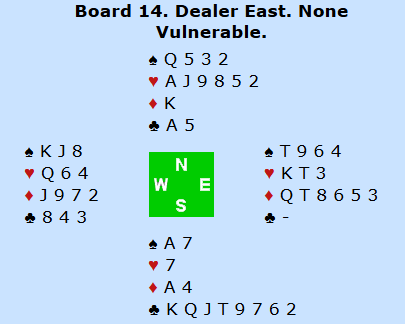
Slam is clearly cold on this deal, but what about the grand? With hearts breaking 3–3, it appears declarer can simply ruff out two hearts and establish the rest of the suit. So how can the defense stop that plan?
The answer is an opening diamond lead. By attacking diamonds immediately, the defense removes one of dummy's vital entries. After declarer ruffs out the hearts, there is no remaining entry to enjoy the established heart winners, making it impossible to take all thirteen tricks.
Perhaps a different question we should be asking is: how can we navigate the small slam in the first place?
Klukowski | O. Rimstedt | Kalita | M. Rimstedt |
P | 1♣ | ||
P | 1♥ | 2♦ | 2NT |
3♦ | X | P | 4♦ |
P | 4♥ | P | 4♠ |
P | 5♣ | AP |
Kalita injected some pressure into the auction with his 2♦ overcall, and Klukowski turned up the heat by competing with 3♦. Although the meaning of the 2NT bid was unclear to us, it was certainly artificial and may have been some form of good bad 2NT. After the 4♠ cue bid, the auction came to an end when Ola Rimstedt signed off in 5♣ despite holding two keycards. Perhaps it was not clear that his partner had a powerful one suited club hand with diamonds under control.
After the diamond opening lead, declarer claimed eleven tricks. Credit should go to Kalita and Klukowski for making the auction awkward enough to steer the Swedes away from the cold slam.
Bertheau | Multon | Hult | Nowosadzki |
P | 1♣ | ||
P | 1♦ (1) | P | 2♠ (2) |
P | 2NT (3) | P | 3♥ (4) |
P | 3♠ | P | 3NT |
P | 4♣ | P | 4♠ |
P | 4NT | P | 5♣ (5) |
P | 5♦ | P | 5NT (6) |
P | 6♣ | AP |
Hearts
GF, either natural or single-suited clubs
Relay
Single-suited clubs with short hearts
3014
Queen of trumps, no outside kings
After a long artificial auction without interference, the Swiss pair successfully navigated to the small slam without venturing too high. Knowing that partner had a heart shortage and no outside kings other than the ♣K he had already shown, Multon settled for 6♣, implying that the partnership likely had a spade loser.
A grand slam would have been cold if South had held a 1=1=3=8 distribution, although with that shape the bidding might well have taken a different course.
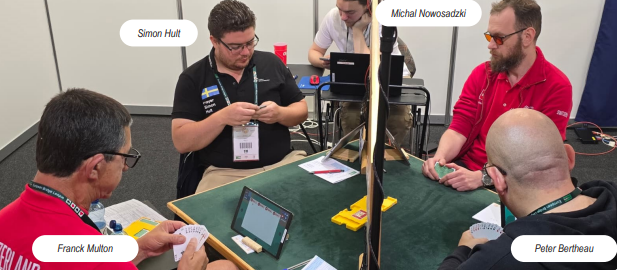
After picking up 22 IMPs on the final three boards of the set, the Swiss emerged with a 34–18 victory, keeping both teams firmly in the race for qualification.
The bigger question, however, was what would happen next.


Comments